We feel different the moment we enter the forest. New growth towers over us as it becomes darker and all sounds gently fade. It feels different, but not overwhelming. The trees envelop us, filling our lungs with oxygen, gently exchanging it for the carbon dioxide we breathe out.
It feels weirdly familiar, calming. Like returning somewhere forgotten, feeling held. We walk through, follow the path, photograph, record soundscapes and take notes.
It does not just happen one way, the forest is taking notes too. Trees in their rings, document the temperature, the change of seasons, humidity, soil, and atmospheric content. They observe and watch over humanity, taking notes on the mark we leave on Gaia.
On a very core, essential level we are so deeply connected. So at what point has it shifted? Why did we become so separated from the forest?
On our second day, we go and see an ash log being milled. Noisy machinery sliced the log strapped to the machine quickly, with precision. As the hardwood that was hidden inside, protected by the trunk is exposed to air it changes colour, getting a pink tinge.
In the evening we discuss the process, discovering that half of us felt uncertain and disturbed by the process, pondering whether people milling felt sad in the process. Why did we feel so disturbed?

Another half was excited about the potential of the timber, and what it can become as a result of their craft.
It is not often that we think about how objects around us are made. Most people own at least one wooden object, but how many questioned the species of the wood it is made from, its origin, and wondered about its story?
As humans we want our objects to be uniform, and smooth. Moreover, we do not like when things change with time, shifting from their original design. We are obsessed with preserving, keeping, and maintaining.
But what if the timber has different ideas? As I cut the ash log into very thin discs and leave them aside, they start moving.
They warp and bend as they dry. At first, they looked like a perfect set of plates, flat and uniform, but after a day they look peculiar and unusual. They are hard to balance and it gets even harder to balance anything on top. To me, they are no longer functional plates, but what if it is a perfect plate for a tree? How would a tree design a plate?
At the end of its lifecycle in the forest, a tree remains as standing deadwood, slowly decomposing, housing thousands of birds,
insects, bacteria, and fungi. It will practically become absorbed back into the forest, broken down, and reborn again. Since this ash got taken away and turned into this nonhuman plate, the next question arises naturally: What would a tree want on a said plate? What can I put in these plates to replace the resources we took away from the forest?
Instead of just taking the material away, how can I learn from it and give something back?
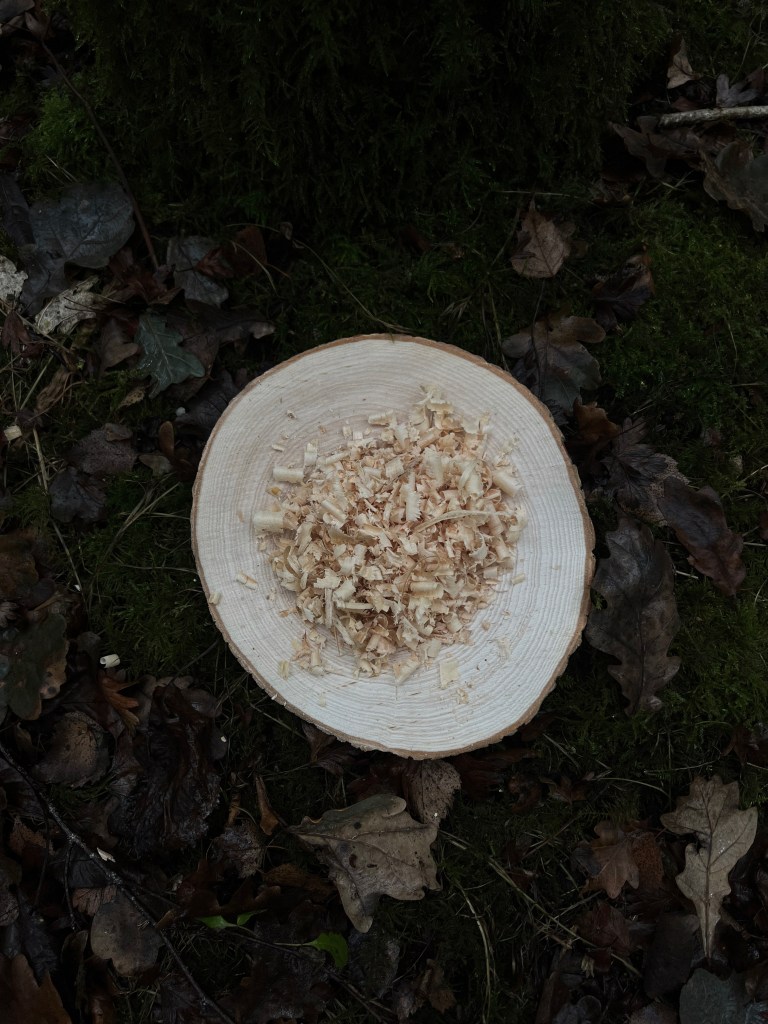
In many pagan religions people once had a strong connection to the forest. It was seen as a mysterious place with its own mind. In many religions, that connection was kept through rituals. In Slavic paganism, people brought offerings to the forest to ask for a good harvest or as an act of celebration and respect for all that forests provide for us.
Part of it involves removing the human-centric thinking and losing control over the forest and instead observing it, treating it as an equal. What if that custom is the key that provides answers to the climate emergency we are facing today?
In my own ritual of exchange with the ash tree I bring the plates into the forest and find an ash tree. Where the plates were unstable on the workshop table, they fit naturally between the sticking-out roots and the wet soil.
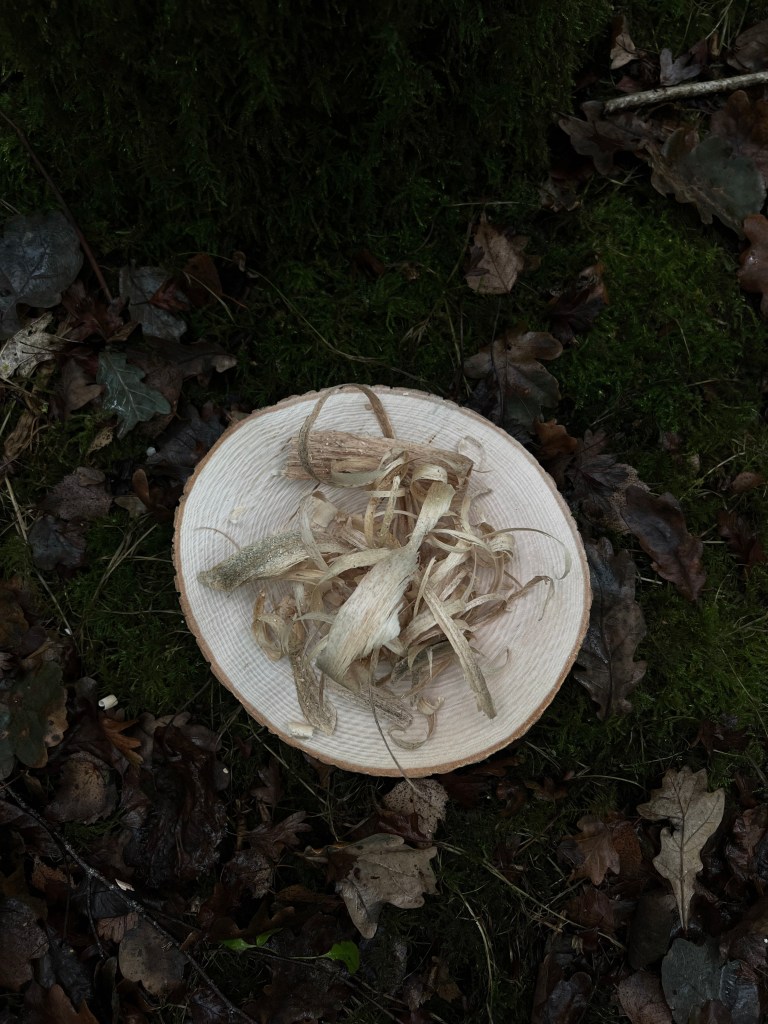
The plates are filled with wood shavings that still contain mycorrhizal species that will help the trees grow, plugging new growth into the mycelial networks of the forest.
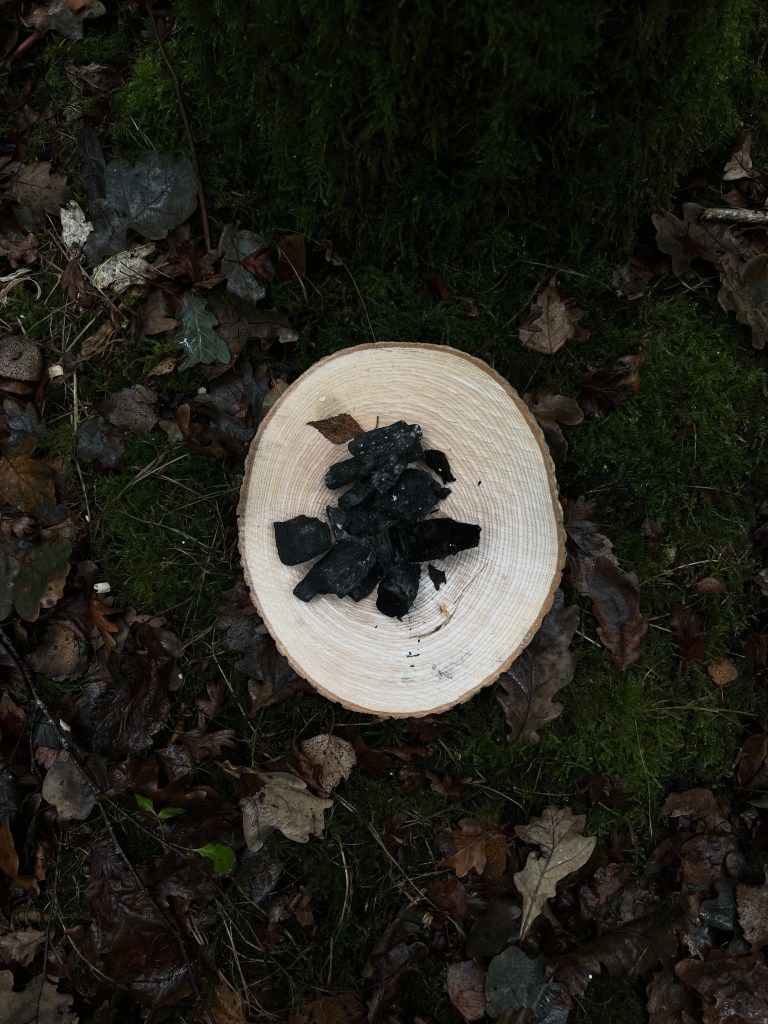
Charcoal from the campfire will add minerals to the soil, balancing its acidity.
Sawdust from the machines will insulate the soil, protecting the new growth in winter.
The plates themselves will decompose over time, naturally, giving all their nutrients back into the soil together with their offerings, nourishing the ash tree.
What if the very basic principle of this ritualistic exchange was at the very core of environmental politics? What if the timber
production industry focused on trading with the forests through this gentle, mindful exchange instead of just extracting resources?
 Oni/Ih Studio
Leave a comment